Birth of a Kingdom

January 22, 2026

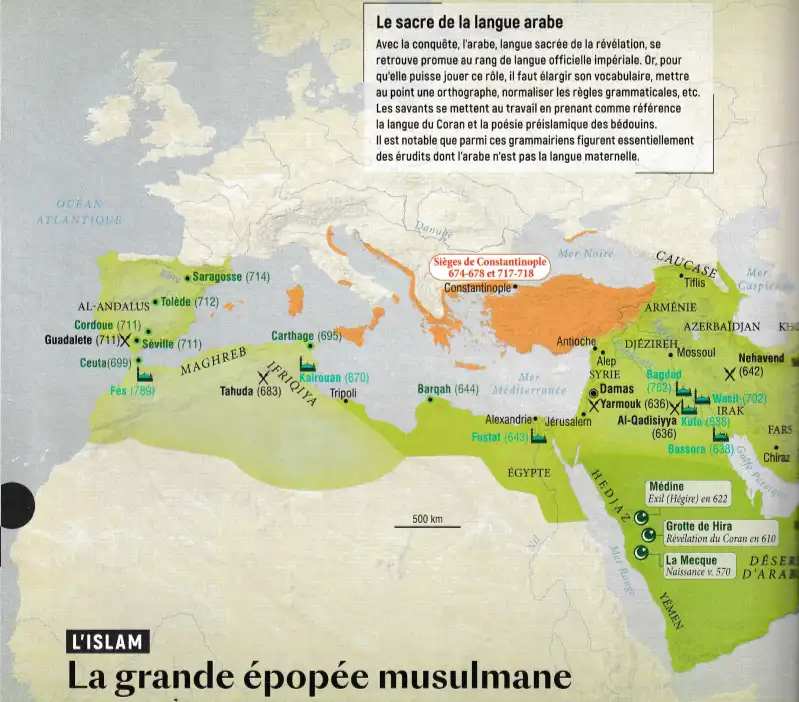
The disciples of the Prophet Muhammad took control of North Africa within a few years, starting at the end of the 7th century. However, the Berber tribes of the mountain regions continued to rise up against the Arab invaders. Around half a dozen kingdoms shared the territory, ruled by Muslim sovereigns of either Sunni or Shiite faith. Within the population, however, Christian and Jewish minorities remained significant. Jewish communities were particularly numerous along the southern trade routes, where many Jews from the diaspora settled and converted neighboring Berber populations.

Fleeing the fighting between Muslim factions, an Arab prince—also known as a sharif—born in Mecca, sought refuge in the Middle Atlas. His name was Idriss, and he was one of the grandsons of Ali, companion of the Prophet Muhammad, and of Fatima, the Prophet’s daughter.

Idriss was welcomed by the Berber tribe of the Aouraba, who lived around Volubilis, a city founded by the Romans in the heart of Mauretania Tingitana, on fertile cereal plateaus near present-day Meknes.

Recognized as king, the newcomer rejected the authority of the Abbasid Caliph of Baghdad. He married the daughter of the Aouraba chief and took the name Idriss I.

After three years of reign, he was assassinated by an agent of the Caliph of Baghdad, Harun al-Rashid. His wife, who was pregnant, later gave birth to a son who would rule under the name Idriss II.

Idriss II unified northern Morocco under his dynasty, the Idrissids. He left Volubilis and transferred his capital some sixty kilometers away, to Fez, in the magnificent Saïs plain at the foot of the Middle Atlas.

The city thus became the first cradle of Moroccan culture and the capital of the kingdom.

The kingdom lived in fierce independence, while maintaining close—and sometimes violent—relations with the Arab Emirate of Córdoba and, later, with the Catholic monarchies of Spain, as well as with Turkey.

Nestled against the first slopes of the Zerhoun massif above the fertile plain of Meknes, the village of Moulay Idriss surrounds with its white houses the tomb and magnificent mausoleum of Idriss I, which has become a major place of pilgrimage for Moroccans unable to afford the journey to Mecca.


Fez el-Bali

Idriss I (743–791) is primarily remembered for initiating the foundation of the city of Fez at the end of the 8th century, in the area of today’s Andalusian Quarter. After his assassination by the Abbasids, his lineage did not come to an end.

His son, Idriss II (791–828), carried on his legacy and completed the founding of Fez, which was divided into two settlements on opposite banks of the Fez River. These two parts would only be unified nearly three centuries later by the Almoravids.

Nicknamed the Florence of Africa and the first Moroccan site listed as UNESCO World Heritage (1981), Fez is the mother city of the kingdom and one of the most prestigious cities of Islam. It has preserved its medieval structure and high ramparts pierced with openings to allow moisture to escape during heavy rains.

The historic heart of the city, completed by the Idrissids in the 9th century, is divided into the Andalusian Quarter to the east and the Kairouan Quarter to the west, both enclosed within a single wall in the 11th century by the Almoravid sultan Youssef Ben Tachfine. Today, it is a sea of rooftops, domes, and minarets. It contains some of the most beautiful buildings in Morocco, including two 9th-century monuments: the Andalusian Mosque and the Al-Qarawiyyin Mosque.

The old city is entirely pedestrian. It includes around 10,000 streets, generally very narrow, making car traffic impossible and even motorcycle access difficult due to frequent stairways. For the same reasons, bicycles are impractical. Donkeys and horses therefore take over, just as they did at the time of the city’s foundation.

The Medina is a labyrinth of nearly a thousand dead ends and is without doubt the largest, oldest, and most authentic medina in Morocco and North Africa. With Baghdad and Damascus having been partially destroyed, Fez remains the only great mythical city of the Arab world to have remained almost intact for twelve centuries.

As early as the 13th century, the city counted no fewer than 120,000 houses and 176 mosques, including the famous Qarawiyyin, which made Fez el-Bali a spiritual, intellectual, and cultural capital attracting merchants and soldiers, travelers and pilgrims, scholars and exiled mystics.


Fez and the Qarawiyyin

At the heart of the dense urban fabric of Fez el-Bali, the Qarawiyyin Mosque is also the oldest university in the world.

Remarkably, its construction in 859 is attributed to a woman from Kairouan who had settled in Fez. Financed by the personal wealth of Fatima al-Fihriya, it was originally a modest building. In the 12th century, the Almoravid sultan Ali Ben Youssef quadrupled its size, and in the 14th century the Marinids expanded and embellished it further, notably adding a library. In the 16th century, the Saadians renovated this library, and each sovereign contributed ancient manuscripts.

All sciences were taught there: Islamic law, Qur’anic exegesis, grammar, mathematics, astronomy. Students came from all over the world. Among those educated there were Averroes (1126–1198), Ibn Arabi (1165–1240), Ibn Khaldun (1332–1406), Hassan al-Wazzan known as Leo Africanus (1494–1527), and even the first French pope, Sylvester II (938–1003).

To this day, Qarawiyyin continues to provide Qur’anic education, and its library preserves thousands of ancient manuscripts.

The mosque can accommodate up to 20,000 worshippers and has 14 entrances. Its courtyard, paved with 50,000 zellige tiles, features two Saadian-era fountain pavilions (1554–1659), similar to those in the Court of the Lions at the Alhambra in Granada. As a sign of prestige, its double-pitched roofs are entirely covered with green tiles known in Arabic as qermoud.


Fez – The Tijani Quarter

Fez contains nearly 9,000 streets forming countless micro-neighborhoods. The Tijani Quarter, formerly known as Dardas and later Blida, takes its name from the important zaouia (religious brotherhood center) founded at the end of the 18th century by the Sufi Sheikh Sidi Ahmed Tijani.

It is said that in this place, devout ears can hear the divine voice…

Each year, countless pilgrims arrive from the Maghreb and especially from sub-Saharan Africa, where the Tijaniyya spiritual path has spread widely.


Fez – Bou Inania Madrasa

The prestigious Qarawiyyin University required housing for hundreds of foreign students. Under the Marinids, Fez—having become a major center of Islamic civilization—was endowed with eleven madrasas (Qur’anic schools), jewels of Hispano-Moorish art.

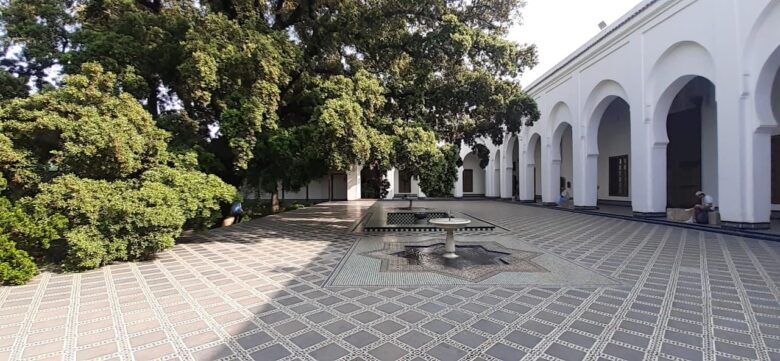
Built in 1355 on Talaâ Kebira Street by the great ruler Abu Inan, the Bou Inania Madrasa served as a college, student residence, and also as a grand mosque where an imam led Friday prayers. Its central courtyard, paved with marble and onyx, is richly decorated with cedar wood, polychrome tile mosaics, and finely carved plaster by the finest craftsmen of Fez.


Fez – Attarine Madrasa

Built near the Qarawiyyin Mosque, the Attarine Madrasa, smaller than Bou Inania, was constructed in 1325 by the Marinid sultan Abu Saïd Othman.

It is characteristic of medieval Islamic colleges: a patio lined with polychrome tiles centered around a marble basin from Italy; alabaster columns topped with carved capitals; pillars decorated with carved ceramics; finely worked cedar doors, ceilings, arches, and lintels; sculpted plaster intrados and stalactite arches.

Regardless of their sophistication, decorations rely on only three types of motifs: geometric, vegetal, and epigraphic.


The Mausoleum of Idriss II

The Mausoleum of Idriss II, marking the completion of Fez in 809, was built under the reign of Moulay Ismaïl at the beginning of the 18th century and restored in the middle of the following century. All alleys leading to the sanctuary are marked by wooden beams indicating the sacred boundary and forbidding access to pack animals.

It is the most revered holy site for the people of Fez and for pilgrims from distant regions who come to seek baraka, the blessing of God. Each year, during the saint’s festival (moussem), the catafalque covering the tomb is renewed, and the city’s craft guilds parade through the medina.

Leave a Reply

Your email address will not be published. Required fields are marked *

Close
Close