
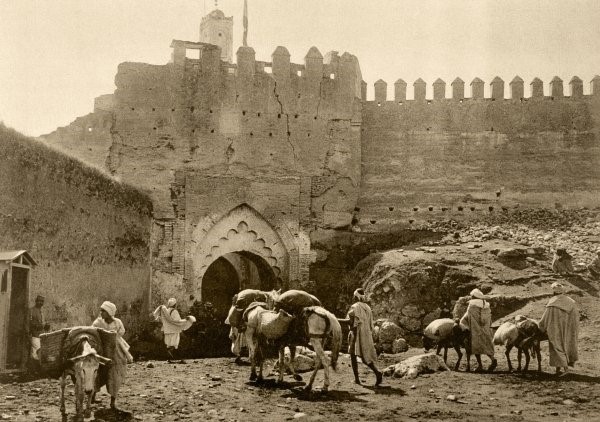
Every day, between the afternoon prayer and sunset, the surroundings of Bab Guissa would host numerous storytellers, drawing large and loyal crowds made up exclusively of men. The storytellers, known as “Cheikhs,” stood on the slope of the hill and recounted to their audience—seated in a circle around the tombs—the glorious epics of El Antaria or the bloody tales of El Ismaïnia.
Most of these storytellers were known as ghzawat storytellers (tales of martial exploits). Accompanied by the rhythm of a square tambourine, they chanted the heroic deeds of the Arabs of olden times. Most listeners—around fifty in winter and up to two hundred in the fair season—already knew the stories and would correct the narrator or prompt him if his memory failed. Yet they took great pleasure in hearing, for the hundredth time, the accounts of cavalry raids, single combats, betrayals, and daring feats, allowing themselves to be lulled or moved by the stereotyped formulas that returned again and again.
Roger Le Tourneau, “Fès avant le protectorat”, 1949
El Antaria belongs to pre-Islamic poetry. Antara, the poet of the desert, was the son of Cheddad; his name was later taken up by popular storytellers of the Romance of Antar to embody the virtues attributed to the wandering paladins of pagan tribes.
El Ismaïlia recounts the story of the Ismailis and the Sheikh of the Mountain. Unlike the former, which can be obtained fairly easily, El Ismaïlia was never written down and is transmitted only orally from one cheikh to another. There must therefore be many variations among the different versions of this poem.
Michaux-Bellaire, Description of the City of Fez, 1906
These storytellers, whose narratives were often marked by extreme intensity, accompanied their tales with gestures, passionately acting them out. Their audience consisted mainly of craftsmen and workers from various trades whose workshops were (and still are today) located near Bab Guissa.
They would come after work to rest while waiting for sunset.
Women did not attend the storytellers of Bab Guissa; they had their own gathering place every Wednesday at Moulay Ali Bou Ghaleb, where storytellers and fortune tellers would also appear.
The most famous of these storytellers was Ba Dris el-Fadwi. His repertoire included three great cycles that lasted from four months to a full year: the story of Antar lasted one year, that of the Ismailis six months, and that of Saïf Dhou ’l-Yasal—a marvelous tale in the spirit of The Thousand and One Nights—lasted four months. Between these major “series,” he would intersperse shorter stories lasting from three to seven days. At the end of the evening, a listener would collect donations for Ba Dris. This renowned storyteller could neither read nor write and worked as a babouche maker; he repeated, with great talent, stories he had heard told.
It is said that his fame reached Sultan Abdelaziz, who wished to hear him—and even to have him perform for the women of the palace, allegedly intending to have his eyes put out for that purpose. Ba Dris refused, and the people of Fez intervened with the Sultan, who eventually abandoned his plan, allowing Ba Dris to continue captivating his audience. After his death, he was replaced by a traveling coffee seller who had sold coffee to the listeners and had heard all the stories. However, it is said that he did not possess the same talent…
In 1945, the storytellers gained a distinguished listener: Louis Jouvet, who stayed in Fez for about fifteen days in March–April 1945. Jouvet’s favorite interpreter, the actress Monique Mélinand, had been hospitalized at the Auvert Hospital in Fez with scarlet fever. Forced to remain in Fez with her, Jouvet, director of the troupe, stayed at Palais Jamaï. Far from lamenting a stay that delayed his departure for France, the artist fully savored the charm of the medina and the Bab Guissa district.
Every evening, accompanied by his friend Dr. Escalle, he would go to listen—amid the medieval setting of the old crenellated towers of the walls of Fez—to the popular storytellers surrounded by their seated audience. He never failed to remark that these storytellers, with their vivid narratives and expressive gestures, were the very source of theater and, like ancient bards, evoked through word and movement scenes and tales passed down through the ages. He admired this return to origins, preserved intact in Fez after millennia, and declared that he found there a rare and precious source of inspiration.
In the past, every Friday around three o’clock in the afternoon, a bird market would take place in the same area near the walls of Bab Guissa: serins, goldfinches, and greenfinches sold in small wicker cages made locally.
Today, the storytellers have disappeared, but the bird market still survives—under the protection of God and the souls of the poets…